MEMORANDUM IN SUPPORT OF
DOUGLAS COUNTY DAMAGES CLAIM
TO: Roger A. Hartman
Douglas County Assessor
1036 S.E. Douglas Ave., Room 206
Roseburg 97470
Oregon, USA
FROM: Paul Andrew Mitchell, B.A., M.S.
Private Attorney General, 18 U.S.C. 1964; and,
Agent of the United States as Qui Tam Relator:
False Claims Act, 31 U.S.C. 3729 et seq.
DATE: November 28, 2017 A.D.
SUBJECT: Douglas County Damages Claim (dated 5/24/2017)
Greetings Roger Hartman:
This MEMORANDUM itemizes a number of topics which have arisen after the People of Douglas County (hereinafter “the People”) lodged their DOUGLAS COUNTY DAMAGES CLAIM dated 5/24/2017. Even though you may already be aware of some of these topics, we wish the written record in this matter to reflect each of the following:
(1) 10-year Discovery Window
As you already know or should know, the Federal RICO statute at 18 U.S.C. 1961(5) expressly authorizes a discovery window spanning a period of ten (10) full years. The People have recently notified the Douglas County Commissioners of their intent to expand the discovery window to a period beginning with the Fiscal Year ending June 30, 2005 to the present. See the attached “Douglas County Damages Claim: Nomenclature and Schedule of Interest Accruals by Fiscal Year”. Our reading of applicable case law calls for the conclusion that the statute of limitations in Civil RICO lawsuits can be tolled until the plaintiffs have enough information to sue.
(2) Summaries of Property Tax Collections
The People have acquired copies of the SUMMARY OF PROPERTY TAX COLLECTIONS as recorded by the County Clerk for seven (7) Fiscal Years ending June 30, 2010 thru June 30, 2016. For RICO Years 6 thru 10, we find the following entries in those SUMMARIES for “Amount of Personal Property Taxes Certified”:
FY 2009-2010 $3,226,751
FY 2010-2011 $3,048,375
FY 2011-2012 $3,014,572
FY 2012-2013 $3,163,497
FY 2013-2014 $3,297,524
By dividing your determination of $14 Million total overcharges by the same 5 years in question, the average is $2.8 Million per year.
Shown as a percentage of Personal Property Taxes Certified, the overcharges appear to be exorbitantly high. This, in turn, gives us reason to suspect that the certified numbers in those SUMMARIES may be incorrect. We would certainly appreciate receiving your written explanation for these apparent discrepancies.
(3) Silence Activates Estoppel
Attached also please find a preliminary list of court decisions which have held that silence is a fraud where there is a legal or moral duty to speak, or where an inquiry left unanswered would be intentionally misleading. Moreover, the consensus of those court decisions is that silence activates estoppel. Except for timely disclosure of Douglas County’s insurance policies in effect during RICO Years 6 thru 10, the Risk Manager(s) and the Commissioners have all fallen silent after receiving a series of proper INVOICEs for full payment of the $14M overcharges plus penalties. As such, the People now regard Douglas County to be legally estopped by the decision of key officials to fall totally silent after receipt of those INVOICEs.
(4) Late Filing Penalties on Business Personal
Property
In your Guest Column published in The News-Review on April 30, 2017, you made the following statement: “We discovered several hundred thousand dollars of ‘erroneous’ late filing penalties, also associated with business personal property. Those also have been eliminated.” It is unclear to us whether or not those erroneous late filing penalties have been refunded to the affected business personal property taxpayers, or not. The People hereby request your written clarification of this question.
(5) Refunds of Real Property
Accounts
Also in your Guest Column supra, you made the following statement: “... another 3,000 to 4,000 real property accounts were value corrected as well, and refunds to taxpayers were processed.” The People regard the latter admission to be extremely relevant in the context of proving deliberate failure to issue refunds to all business personal property taxpayers, who were damaged by $14M overcharges.
(6) Adjusted INVOICEs December 1, 2017 A.D.
Enclosed also please find copies of our INVOICEs for the DAMAGES CLAIM and MANAGEMENT FEE, adjusted to add all accrued interest and all applicable elder abuse penalties. We have mailed post-dated copies of same to the Board of Commissioners (“BOC”), to provide them with an opportunity to correct any obvious errors. The People also intend to invoke estoppel against Douglas County if all three Commissioners choose again to fall silent, rather than to contest and/or correct any of the calculations showing on those post-dated INVOICEs.
(7) Elder Abuse Cohort Assumption
Based on information we obtained from searching the Internet, the elder abuse penalties on the latter INVOICEs were based upon the assumption that seniors comprise thirteen percent (13%) of the total county population. If more accurate and more current demographic data can be made available, the People intend to adjust future INVOICEs with the more accurate demographic data.
(8) Legal Representation in Hansen v. Hartman et al.
We have recently examined the Circuit Court’s docket in the matter of Docket Number 17cv34310, and we do not find any Counsel listed next to your name. The People have an interest in knowing the identity of the Counsel(s) you have authorized to represent you in that lawsuit.
(9) Security Lock on Docket Entries in 17cv34310
After the Circuit Court Clerk completed a brief remodeling project, the public access computer was re-enabled. However, several docket entries are not open to public access. Instead, the following error message is generated when a SiteKiosk user attempts to read certain docket entries: “For security reasons this action is not allowed.” That error message is problematic for the Undersigned, chiefly because Jessica Hansen’s initial COMPLAINT contained defamatory statements which have not been retracted by her attorney. It is very possible that the “locked” docket entries may contain further defamatory statements, copies of which are needed as evidence of further elder abuse.
(10) Rationale for Compound Interest
ORS 82.010 uses the term “simple interest” in one and only one context, namely: “Interest on a judgment under this subsection is simple interest, unless otherwise provided by contract.” Because simple interest is not mandated for accrual of interest prior to entry of judgment by a court of competent jurisdiction, the People have taken advantage of that omission to claim accrual of compound interest beginning RICO Year 6, right up to the present.
(11) Other Relevant Documentation at Assessor’s
Website
The People also have a need to know if the Internet website for the Douglas County Assessor’s Office presently archives any other documentation which may be relevant to the refunds of real property taxes and business personal property taxes, particularly for the periods now identified as RICO years 6 thru 10 inclusive. Please disclose such documentation, and please also remember to honor this request if and when any such documentation should be made available at that website in the future.
(12) Schedule for Publication of
CAFR
The most recent Comprehensive Annual Financial Report (CAFR) that is available at Douglas County’s website is the one for Fiscal Year ended June 30, 2016. Jessica Hansen’s transmittal letter was dated December 28, 2016. The People also have a need to know the planned or expected publication date of the latest CAFR for the Fiscal Year that ended on June 30, 2017. For example, if the same delay occurs, can we expect publication of the latest CAFR on or about December 28, 2017?
(13) Missing Financial Reports
For calendar year 2017, at the Douglas County Internet website there is only one available document entitled “Douglas County Treasurer’s Investment Activity” which is dated May 31, 2017. There are no such reports for any other months during calendar year 2017. By comparison, there are twelve (12) such reports for calendar year 2016. The People regard these obvious omissions with reasonable suspicion, particularly insofar as these reports are mandated by State laws.
(14) Roger A. Hartman’s Resume
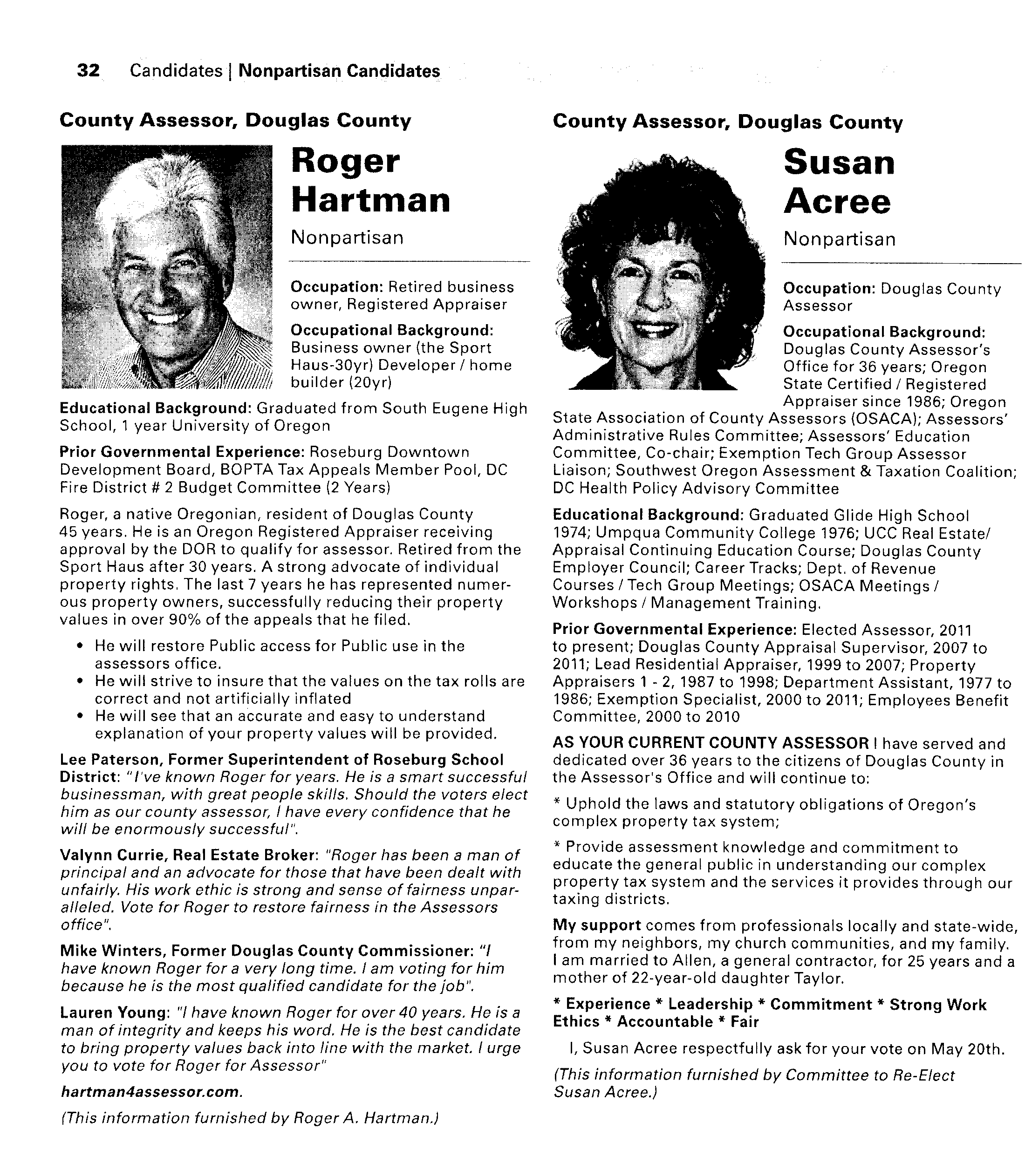
The People also have an interest in obtaining a current copy of your professional resume. We have attached a copy of your entry in the Voter’s Pamphlet for the 2014 primary election. The reason for our interest in your professional resume is to assemble a complete record of your relevant professional experiences which uniquely qualify you to confirm your discovery of $14M in business personal property tax overcharges. Likewise, we also wish to obtain copies of the professional resumes for Susan Payne and Frank Lassen. And, if possible without violating any privacy rights, the People also have a desire to know Frank Lassen’s medical history.
(15) Appropriate Dispute
Resolution (“ADR”)
The People have already submitted one request to Commissioner Gary Leif for an opportunity to explore alternative dispute resolution in the matter of their unpaid INVOICEs and the past due refunds of the $14M overcharges. Because the BOC have fallen totally silent, we have yet to receive any reply(s) to that request. The People wish to make a record of their desire and preference to expedite settlement without needing to petition a court of competent jurisdiction for all remedies to which they are entitled.
(16) Definition of “Scheme or
Artifice to Defraud”
The People also wish to take this opportunity to request your good offices to take particular notice of the Federal statute at 18 U.S.C. 1346, to wit: “For the purposes of this chapter, the term ‘scheme or artifice to defraud’ includes a scheme or artifice to deprive another of the intangible right of honest services.” We feel the latter statute is particularly applicable to the outstanding DAMAGES CLAIM, chiefly because of the very large number of tax bills that were transmitted via U.S. Mail, and the similarly large number of payments of overcharges which were remitted via U.S. Mail. The evidence already available to us calls for the conclusion that certain Douglas County officials have been engaged in providing dishonest services to the People of Douglas County.
(17) Risk Management Procedures
Also attached please find a copy of RULES FOR IMPLEMENTATION AND ADMINISTRATION OF COUNTY RISK MANAGEMENT PROGRAM, which we obtained from Douglas County’s Internet website. It is painfully evident to us, at this late date, that by falling totally silent Douglas County officials have chosen to ignore their own administrative procedures which were adopted expressly to implement its policies for processing proper and timely DAMAGES CLAIMS. We invite you, in particular, to review all paragraphs in Section 7: Settlement of Claims. Section 7.6 makes mention of “the urgent need to respond vigorously to liability claims”. We do not mean to be smug by observing that total silence is diametrically opposite to a vigorous response.
(18) Missing OATHs for Department
Heads
In closing, the People also wish to make a record of the fact that fourteen (14) Douglas County Department Heads have disclosed OATHs OF OFFICE, whereas nineteen (19) have NOT done so. We regard this pattern of missing credentials to be rather serious, notwithstanding any theory of “de facto officer” which those 19 Department Heads might try to offer in their own defense. If the rule of Law is to mean anything here in Oregon, then it follows that the People have an additional cause of action against any and all county personnel who persist in violating Article VI, Clause 3 in the U.S. Constitution, Article XV, Section 3 in the Oregon State Constitution, and the Act of Congress at 4 U.S.C. 101. Oregon counties are political subdivisions of the Oregon State Government and, as such, they are also subject to the Supremacy Clause in the U.S. Constitution. Fortunately, the Oregon State Constitution does not appear to conflict with the U.S. Constitution on this point.
Thank you very much for your continuing professional consideration in all matters discussed above.
Sincerely yours,
/s/ Paul Andrew Mitchell
Paul Andrew Mitchell, B.A., M.S.
Private Attorney General, Civil RICO: 18 U.S.C. 1964;
Agent of the United States as Qui Tam Relator (4X),
Federal Civil False Claims Act: 31 U.S.C. 3729 et seq.
All Rights Reserved (cf. UCC 1-308)
Attachments (as cited above)
Douglas County
Damages Claim: Nomenclature
and Schedule of Interest Accruals by Fiscal
Year
RICO Compound
Year Fiscal Year Ending Exponent Comment
---- ------------------ -------- -------
1 June 30, 2005 no data
2 June 30, 2006 no data
3 June 30, 2007 no data
4 June 30, 2008 no data
5 June 30, 2009 no data
6 June 30, 2010 1.09^8 yearly @ 9% APR
7 June 30, 2011 1.09^7 yearly @ 9% APR
8 June 30, 2012 1.09^6 yearly @ 9% APR
9 June 30, 2013 1.09^5 yearly @ 9% APR
10 June 30, 2014 1.09^4 yearly @ 9% APR
June 30, 2015 1.09^3 yearly @ 9% APR
June 30, 2016 1.09^2 yearly @ 9% APR
June 30, 2017 1.09^1 yearly @ 9% APR
July 1, 2017 monthly @ 9% APR
Case Law: Silence Activates Estoppel
An agreement inferred from silence rests upon the principle of estoppel. 12 Am.Jur. 533, § 40.
[Letres v. Washington Co-op. Chick Ass’n]
[8 Wn.2d 64, 69 (Wash. 1941)]
Silence, to work estoppel, must amount to bad faith; of such a nature as to induce another to alter his position so that it becomes unconscionable to permit the person remaining silent to enforce his rights.
[Wise v. United States, 38 F.Supp. 130 (1941)]
To constitute an estoppel by silence or acquiescence, it must appear that the party to be estopped was bound in equity and good conscience to speak, and that the party claiming estoppel relied upon the acquiescence and was misled thereby to change his position to his prejudice. (Mettler v. Rocky Mountain etc. Co., 68 Mont. 406, 219 P. 243.) Mere silence cannot work an estoppel. To be effective for this purpose, the person to be estopped must have had an intent to mislead or a willingness that another should be deceived; and the other must have been misled by the silence. (Moore v. Sherman, 52 Mont. 542, 159 P. 966.) The evidence here fails to establish any misleading or willingness to mislead on the part of these plaintiffs; hence there can be no estoppels.
[Sherlock v. Greaves, 76 P.2d 87 (Mont. 1938)]
The elements of this latter type of estoppel are well stated in Nelson v. Chicago Mill & Lumber Corporation (C.C.A.8) 76 F.2d 17, 21, 100 A.L.R. 87: "The essential elements of estoppel, as applicable in this case, are: (1) Ignorance of the party claiming estoppel of the matter asserted; (2) silence concerning matter where there is a duty to speak amounting to misrepresentation or concealment of a material fact; (3) action by the party relying on the misrepresentation or concealment; and (4) damages resulting if the estoppel is denied. [Many cases cited.]"
[James v. Nelson, 90 F.2d 910 (9th Cir. 1937)]
"An estoppel may arise also from silence as well as from words or conduct. But this is only where there is a duty to speak, and where the party upon whom such duty rests, has an opportunity to speak, and, knowing that the circumstances require him to speak, remains silent."
[Merry v. Garibaldi, 48 Cal.App.2d 397 (1941)]
The essential elements of estoppel, as applicable in this case, are: (1) Ignorance of the party claiming estoppel of the matter asserted; (2) silence concerning matter where there is a duty to speak amounting to misrepresentation or concealment of a material fact; (3) action by the party relying on the misrepresentation or concealment; and (4) damages resulting if the estoppel is denied. Grouf v. State National Bank (C.C.A.) 40 F.2d 2; Hirning v. Federal Reserve Bank of Minneapolis (C.C.A.) 52 F.2d 382, 82 A.L.R. 297; California Prune & Apricot Growers, Inc., v. El Reno Wholesale Grocery Company (C.C.A.) 15 F.2d 839; McCullough v. Satterthwait (C.C.A.) 11 F.2d 111; Detroit T. & I. R. Co. v. Detroit & T. S. L. R. Co. (C.C.A.) 6 F.2d 845; Central Improvement Company v. Cambria Steel Company (C.C.A.) 210 F. 696; Pettit-Galloway Company v. Womack, 167 Ark. 356, 357, 268 S.W. 353; Indiana Lumbermen's Mut. Insurance Co. v. Meyers Stave & Manufacturing Co., 164 Ark. 359, 261 S.W. 917.
[Nelson v. Chicago Mill & Lumber Corporation]
[76 F.2d 17 (8th Cir. 1935)]
Estoppel by silence does not arise without full knowledge of the facts, and a duty to speak on the part of the person against whom it is claimed. Blanck v. Pioneer Mining Co., 93 Wash. 26, 159 P. 1077; Proctor v. Appleby, 110 Wash. 403, 188 P. 481; Harms v. O'Connell Lumber Co., supra; 21 C.J. 1152, Estoppel, § 155 b (1); 2 Pomeroy's Equity Jurisprudence (4th ed.), 1680, § 818.
In the Blanck case just cited, Judge Ellis, speaking for the court, concisely stated the limitations of this type of estoppel as follows:
"Full knowledge of the facts is essential to create an estoppel by silence or acquiescence [citing cases]. ... Mere silence, without positive acts, to effect an estoppel must have operated as a fraud, must have been intended to mislead, and itself must have actually misled. The party keeping silent must have known, or had reasonable grounds for believing, that the other party would rely and act upon his silence. The burden of showing these things rests upon the party invoking the estoppel."
[Consolidated Freight Lines v. Groenen]
[117 P.2d 966 (Wash. 1941)]
Silence giving rise to an estoppel, was also discussed in Garrett v. Katz, supra; quoting from an authority, we said: "`Estoppel by silence arises where a person, who by force of circumstances is under a duty to another to speak, refrains from doing so and thereby leads the other to believe in the existence of a state of facts in reliance upon which he acts to his prejudice.' 16 Cyc. 680, footnote 10. The doctrine laid down in the foregoing authorities is undoubtedly approved by our own court. Love v. Barber, 17 Tex. 312, 318; Ragsdale v. Gohlke, 36 Tex. 287; Bynum v. Preston, 69 Tex. 287, 288, 6 S.W. 428, 5 Am. St. Rep. 49; Waggoner v. Dodson, 96 Tex. 415, 423, 73 S.W. 517."
[Lincoln v. Bennett, 135 S.W.2d 632 (Tex. App. 1939)]
Neither estoppel by silence nor estoppel by conduct goes so far. Both rest upon the basis that the silence or the conduct has induced another party to believe in the existence of a state of facts upon which that other party acts to his prejudice.
[New York Life Ins. Co. v. Talley]
[72 F.2d 715 (8th Cir. 1934)]
Silence can only be equated with fraud where there is a legal or moral duty to speak, or where an inquiry left unanswered would be intentionally misleading. ... We cannot condone this shocking behavior by the IRS. Our revenue system is based on the good faith of the taxpayer and the taxpayers should be able to expect the same from the government in its enforcement and collection activities.
[U.S. v. Tweel, 550 F.2d 297, 299]
[U.S. v. Prudden, 424 F.2d 1021, 1032]
Additional Attachments:
http://supremelaw.org/cc/DoCo/risk.management/letter.2017-11-27/admissions.by.silence.1.gif
http://supremelaw.org/cc/DoCo/risk.management/letter.2017-11-27/admissions.by.silence.2.gif
http://supremelaw.org/cc/DoCo/risk.management/Exhibit.B-1.gif
http://supremelaw.org/cc/DoCo/hartman/voters.pamphlet.2014-05-20.gif
http://supremelaw.org/cc/DoCo/risk.management/invoice.principal.5.pdf
http://supremelaw.org/cc/DoCo/risk.management/invoice.6.pdf
http://supremelaw.org/cc/DoCo/risk.management/riskrule.(all).2006.pdf